Sharing a bed should support better sleep, not interrupt it. Yet for many couples, sleep quality drops because of partner disturbance — one person turns, the other wakes; one sleeps lightly, the other moves often; one goes to bed early, the other comes in late.
Over time, these small disruptions add up, leading to broken sleep and daily fatigue. Choosing the right mattress plays a major role in reducing partner disturbance and improving sleep quality for couples.
This guide explains why partner disturbance happens, what mattress features matter most, how motion isolation works in real life, which mattress sizes suit couples best, and what to prioritise if one or both partners are restless sleepers.
Why partner disturbance happens
Partner disturbance happens when movement, pressure, or vibration transfers across the mattress surface. Common causes include:
- Different body weights
When one partner is heavier, the mattress may compress unevenly, causing movement or tilt that the other partner feels. - Frequent turning or repositioning
Restless sleepers naturally shift positions throughout the night, transferring motion across the bed. - Different sleep schedules
One partner getting in or out of bed can disturb the other, especially on mattresses that bounce or lack motion control. - Different firmness preferences
If one partner prefers firm support and the other prefers softer comfort, discomfort can lead to more movement during sleep.
Understanding these factors helps couples choose a mattress that works for both sleepers, not just one.
What matters most in a mattress for couples
- Motion isolation (top priority)
Motion isolation refers to how well a mattress absorbs movement instead of transferring it. For couples, this is often the single most important feature.
A mattress with good motion isolation allows one partner to turn, stretch, or get out of bed without waking the other. - Stable, even support
A couple’s mattress should feel consistent across the surface. Good support reduces the “rolling together” effect and helps each partner maintain proper spinal alignment. - Balanced comfort
Couples usually do best with a medium to medium-firm feel, which offers support without feeling too hard or too soft. This range suits the widest variety of sleeping positions and body types. - Quiet performance
Some mattresses make noise when compressed or moved. For light sleepers, even subtle sounds can interrupt rest. Quiet materials support deeper, uninterrupted sleep.
Best mattress materials for couples (comparison)
| Mattress Material | Motion Isolation | Comfort & Feel | Pros for Couples | Things to Consider |
|---|---|---|---|---|
| Memory Foam | Excellent | Contouring, pressure-relieving | Absorbs movement very well, reduces partner disturbance, quiet surface | Can retain heat if not designed with cooling features; very soft foam may feel harder to move on |
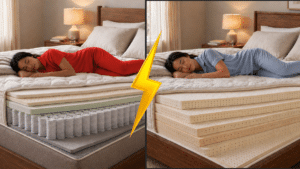
| Latex | Good | Responsive, supportive | Stable feel, cooler sleep, durable | Slightly more motion transfer than memory foam; firmer feel may not suit everyone |
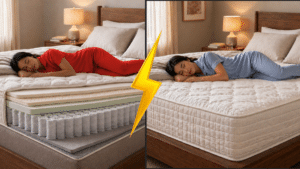
| Hybrid + Lambswool | Moderate to Good | Balanced support | Better airflow, combines support and cushioning | Motion isolation depends on coil and foam quality; pocketed coils perform better |
Understanding motion isolation in real life
Motion isolation is not just a marketing term — it directly affects how couples sleep.
In daily use, good motion isolation means:
- Sitting on the edge does not disturb the other side
- Turning over does not shake the entire bed
- Getting out of bed does not cause excessive bounce
Mattresses with foam comfort layers and independent support zones typically perform better in real-world conditions.
Ideal mattress sizes for couples
| Mattress Size | Best For | Why It Works | Things to Consider |
|---|---|---|---|
| Queen |
Couples in smaller master bedrooms Couples who do not co-sleep with children |
Balances sleeping space with room layout and furniture | May feel tight if one or both partners move frequently during sleep |
| King |
Light sleepers Couples with different sleep schedules |
Provides more personal space and reduces partner disturbance | Requires sufficient room space to maintain comfortable walkways |
| Super King |
Couples who co-sleep with children Those who prefer maximum sleeping freedom |
Offers a spacious, luxury sleep surface with minimal disturbance | Room size and layout must be planned carefully before choosing |
Mattress tips for restless sleepers
If one or both partners move frequently during sleep, consider these additional factors:
- Medium firmness to prevent excessive sinking
- Zoned support to maintain alignment while turning
- Thicker comfort layers to reduce pressure-triggered movement
- Strong edge support to minimise disturbance when getting in and out of bed
In some cases, supportive pillows also help reduce restlessness.
How couples should decide
When choosing a mattress together, prioritise in this order:
- Motion isolation
- Support consistency
- Comfort balance
- Mattress size that fits both sleepers and the room
Instead of choosing based on habit or past experience, focus on how both partners actually sleep. The goal is not just comfort — it is undisturbed, restorative sleep for two people.
Closing thoughts
A good mattress for couples does more than feel comfortable in a showroom. It supports two different bodies, absorbs movement, reduces disturbance, and helps both partners sleep through the night.
By understanding why partner disturbance happens and choosing the right mattress materials, support level, and size, couples can significantly improve sleep quality without compromise.
Better sleep together starts with choosing smarter — not just softer or bigger.